This column I wrote on October 29, 2015 appears in Long Island Now and in Blank Slate Media newspapers.
Archive for the ‘Articles/Essays/Op-Ed’ category
Why I’m voting for Madeline Singas – By George J. Marlin
October 30, 2015George Marlin with Governor Cuomo, Sandra Lee and Mayor de Blasio in St. Patrick’s 1st pew, during Pope’s visit.
September 26, 2015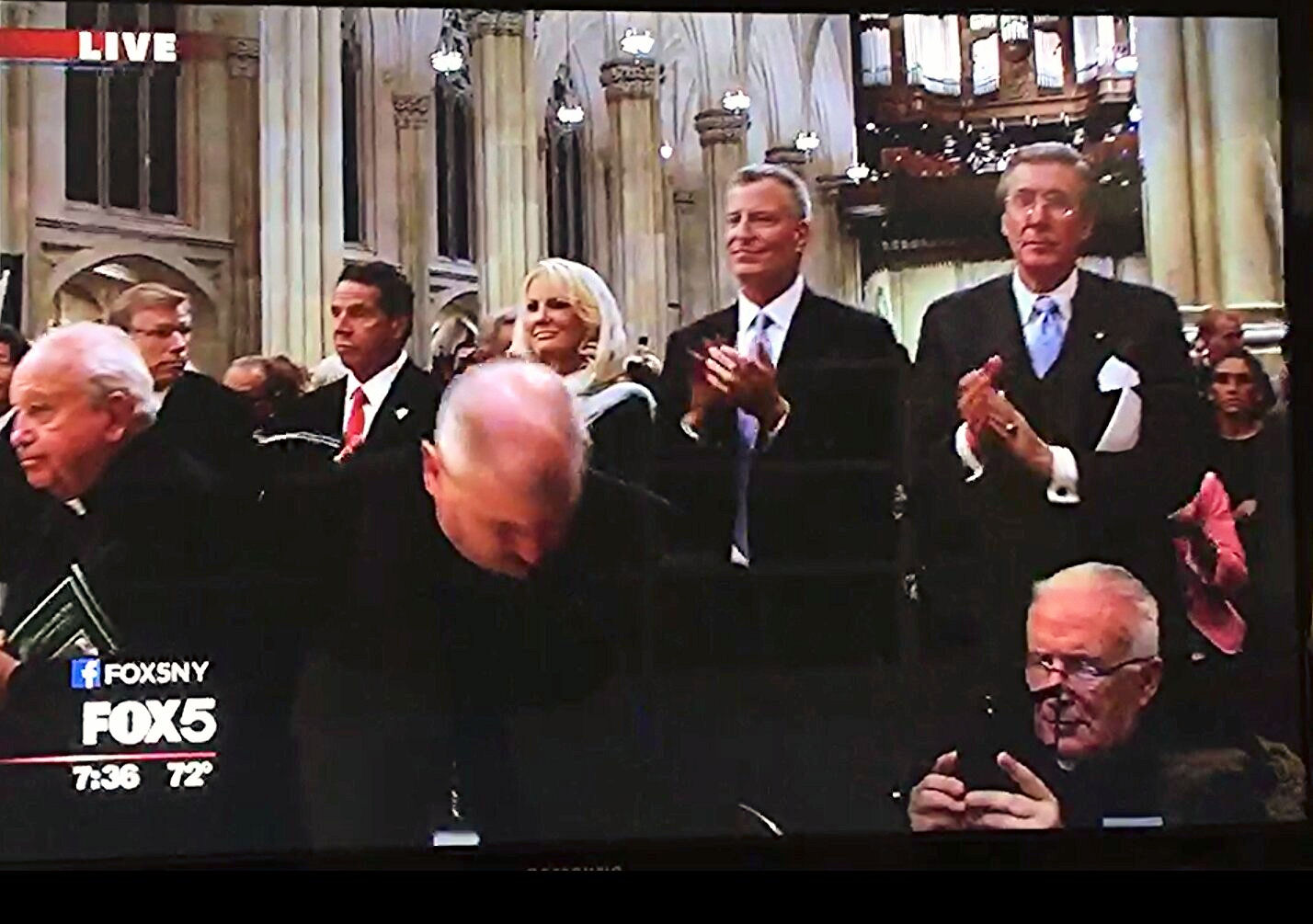
Why LI home values are going nowhere – By George J. Marlin
September 24, 2015The following appears in the September 18-24, 2015 issue of the Long Island Business News:
The Case-Shiller Home Price Index released this month reveals that close to half of single family homes in New York’s metropolitan region have been losing value.
This should not come as a surprise to Long Islanders. Since the end of the Great Recession, with the exception of high-rent districts, most real estate sectors — particularly starter homes for young families—have not been doing well and have not recovered from the 2008 crash.
In 2014, values on Long Island homes edged up less than 1 percent. This anemic result included a 6 percent gain in the highest-end homes in Nassau and western Suffolk County.
Home values in working class areas have been going nowhere for several reasons:
First and foremost: high property taxes. In my neighborhood, New Hyde Park, a starter house, which is often a post-World War II Cape Cod that has not been dormered or expanded, goes for $500,000 and its tax levy is around $10,000 annually.
A potential buyer making the area median annual income of $107,000, who hopes to take on a $400,000 mortgage at 3.875 percent, will have to make a monthly payment of $1,432. Add to that $400 a month for home and auto insurance and $500 for utility and car payments and the annual expenses before property taxes is $27,984. That’s a big number but doable if the buyer is frugal.
But when the taxes are factored in, the annual payout leaps to $37,984—a tough nut to crack when supporting a family on a $100,000 a year gross income. As a result, working class buyers are not willing to pay top dollar for houses and sellers are forced to drop prices.
Another reason why homes are not increasing in value is changing buyer habits. During the frenzy buying years before the 2008 crash, many people paid big numbers for houses even if they needed extensive improvements. Nowadays, if a house is not in “move-in” condition, shoppers will discount their offer. In other words, if the market value of a home is $500,000 and a buyer estimates it needs $100,000 in repairs, the bid for the home could drop to $400,000.
Finally, home prices are declining in areas where the commute to New York City is perceived to be too long. Back in the 1950s, couples moved to eastern Long Island because they could find affordable housing. The trade-off, however, was enduring commutes to the work place. It was not unusual for a commuter to get up each morning at 4:30 a.m., drive to a L.I.R.R. station, catch a train to Penn Station, then take a subway to the office and hope to be in by 9:00 a.m. The return trip would not get the commuter home until nearly 8 p.m.—in time to get a bite to eat and to get ready for bed.
Many people under 35 are not interested in long commutes.
They want to get to work in under half an hour. They are not willing to sacrifice leisure time to own a sizable and affordable house. Instead they’d rather be squashed in a small apartment close to their place of work. (Many young job applicants I’ve interviewed have left my office in a state of shock after I’d described my daily high school commute in the 1960s which entailed taking two city buses an hour and 15 minutes each way.)
The aversion to commuting plus the decline in local working class jobs helps explain why some communities in eastern Long Island have rundown homes that are hard to sell and are slowly turning into ghost towns.
High taxes, a shrinking job base and the exodus of young people are impairing property values. And if the insouciant political class doesn’t wake up and address the crisis, Long Island will eventually have only two classes—the wealthy and their servants.
Chopping up Christians in the Middle East – By George J. Marlin
September 22, 2015This article I wrote appeared in The Washington Times on September 23, 2015.
Nassau’s GOP hearing the death rattle – By George J. Marlin
September 9, 2015The following appears in the September 4-10, 2015 issue of the Long Island Business News:
After the fall of Napoleon, delegates to the Congress of Vienna restored to the French throne the Bourbon heir, Louis XVIII. The King, an obstinate man who surrounded himself with bitter reactionaries, did not last in power. The wily French diplomat, Charles Maurice de Talleyrand quipped, “the Bourbons learnt nothing and forgot nothing.”
Talleyrand meant the King did not learn anything from the beheading of his brother, Louis XVI, and his sister-in-law, Marie Antoinette, in 1793; and during two decades of exile, he did not forget any of his grudges.
It now appears Nassau County’s Republicans, like the Bourbons, have learned nothing from the voter-imposed exile they endured between 2001 and 2009; nor did they forget the fiscal and political antics they employed that brought Nassau to the edge of bankruptcy in the 1990s.
Readers will recall that 30 years of Republican mismanagement, institutional corruption, cronyism and budgetary tricks, caught up in 1999 and the county executive, exposed as the emperor with no clothes, had to go hat in hand to Albany to beg for a bailout.
To help salvage Nassau’s GOP, Gov. George Pataki, in 2000 gave the county government $100 million to help balance their books and created the Nassau Interim Finance Authority (NIFA), a budgetary oversight board with the power to provide the county with budgetary relief, to transmit state assistance and to issue bonds.
However, the financial lifeline did not save the GOP at the polls in November 2001. Irate voters overwhelmingly booted them out. They lost the county executive and comptroller offices and their majority in the Nassau County Legislature.
Eight years later, thanks to the Tea Party movement, Republicans were given a new lease on life. By a very slim voter majority, they gained back the county’s executive and legislative branches.
Repentant GOP County Executive Edward Mangano promised a new municipal era in which the taxpayers would come first. But it was not to be.
Rather than balancing the budget in accordance with Generally Accepted Accounting Principles (GAAP), the Mangano Administration reverted to the deceptive financial practices of the 1990s. It also doled out lavish raises to favored employees and gave away the store to government unions and the politically connected.
Now the law is breathing down the neck of Mangano and his GOP confreres. Scores of U.S. Attorney subpoenas have been issued. Mangano, government vendors, the county’s flawed bidding process, and the financial records of Republican clubs are being investigated.
There’s more: a Newsday investigation revealed that a $17 thousand Mangano vacation was arranged and paid for by a Long Island businessman—and the County Executive has thus far refused to deny the allegation.
In late August, it was reported that Mangano approved hundreds of no-bid contracts totaling $10 million that came under the $25,000 threshold for legislative review and approval. Many “personal service” contracts were awarded to political cronies and contributors.
Mangano’s hometown of Oyster Bay is also in the sights of the Securities and Exchange Commission (S.E.C.) and the U.S. Attorney. The GOP-controlled township may have violated Article 8 of the New York State Constitution which reads in Section I, “No…town…shall give or loan any money or property to or aid any individual or private corporation…or loan its credit to or in aid of any…individual or private corporation….” Not only do records show that the Town of Oyster Bay guaranteed a vendors loan in the case of default, it appears the contingent liability was not disclosed to independent auditors and not revealed in the town’s official statement when issuing bonded debt. Complaints have already been filed with the S.E.C. which takes very seriously breaches of municipal fiduciary obligations.
Nassau’s Republicans learned nothing from the debacle they abetted in the 1990s. But this time instead of being voted out of office, they may be escorted out of office in handcuffs.

